
My Notes from ESHG 2026
Talks and conversations from a week in Gothenburg.

Back in Helsinki after five days of ESHG in Gothenburg. I am still a bit tired, but I want to write things down now. In two weeks all the talks will be mixed together in my head and I will not remember who said what.
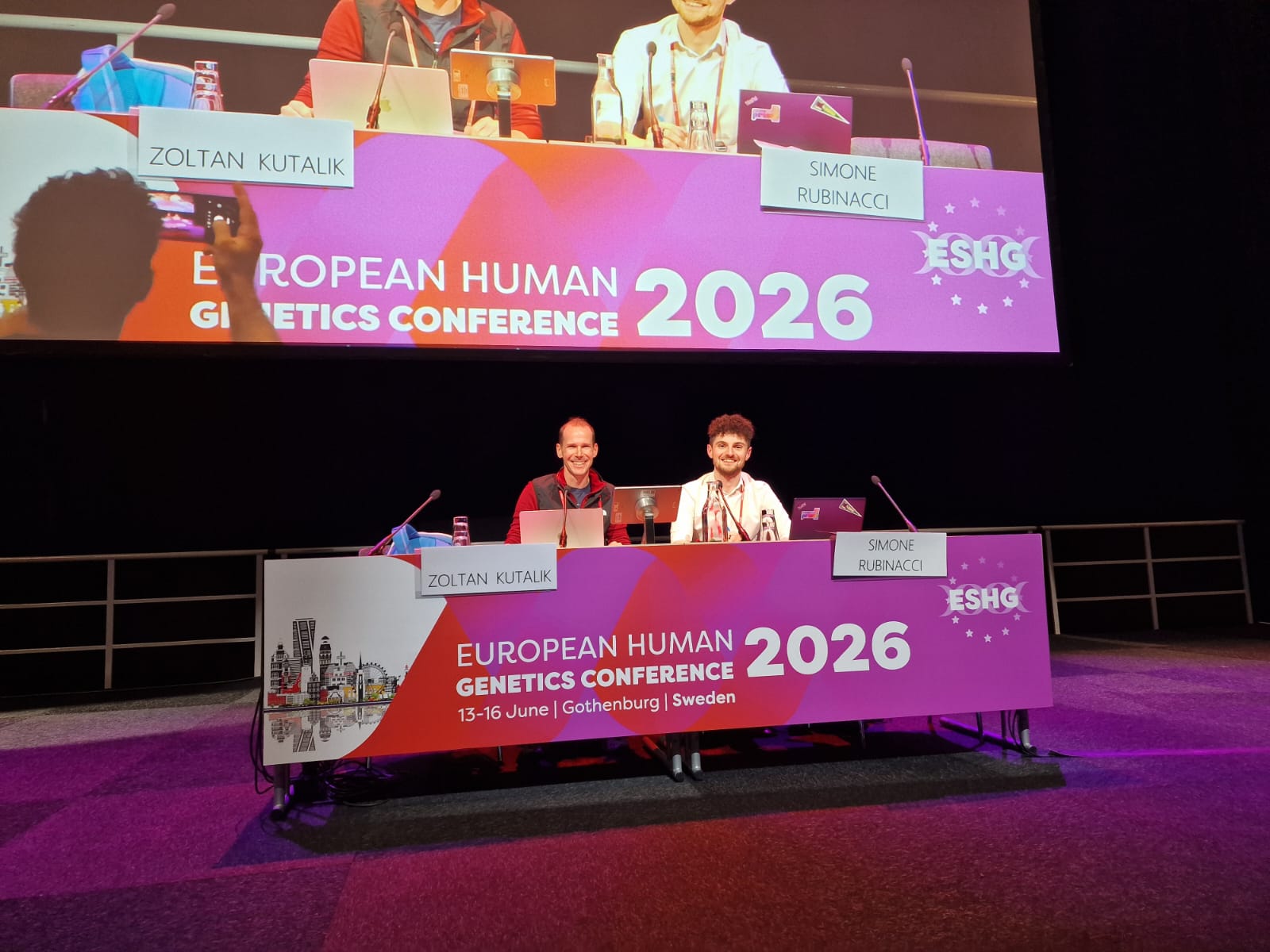
This was a busy ESHG for the lab. I co-chaired two sessions: From Population to Perturbation with Juliana Miranda Cerqueira, and GWAS at Scale with Zoltán Kutalik. The rooms were full and people kept discussing well after the end, which is the best thing that can happen to a chair.
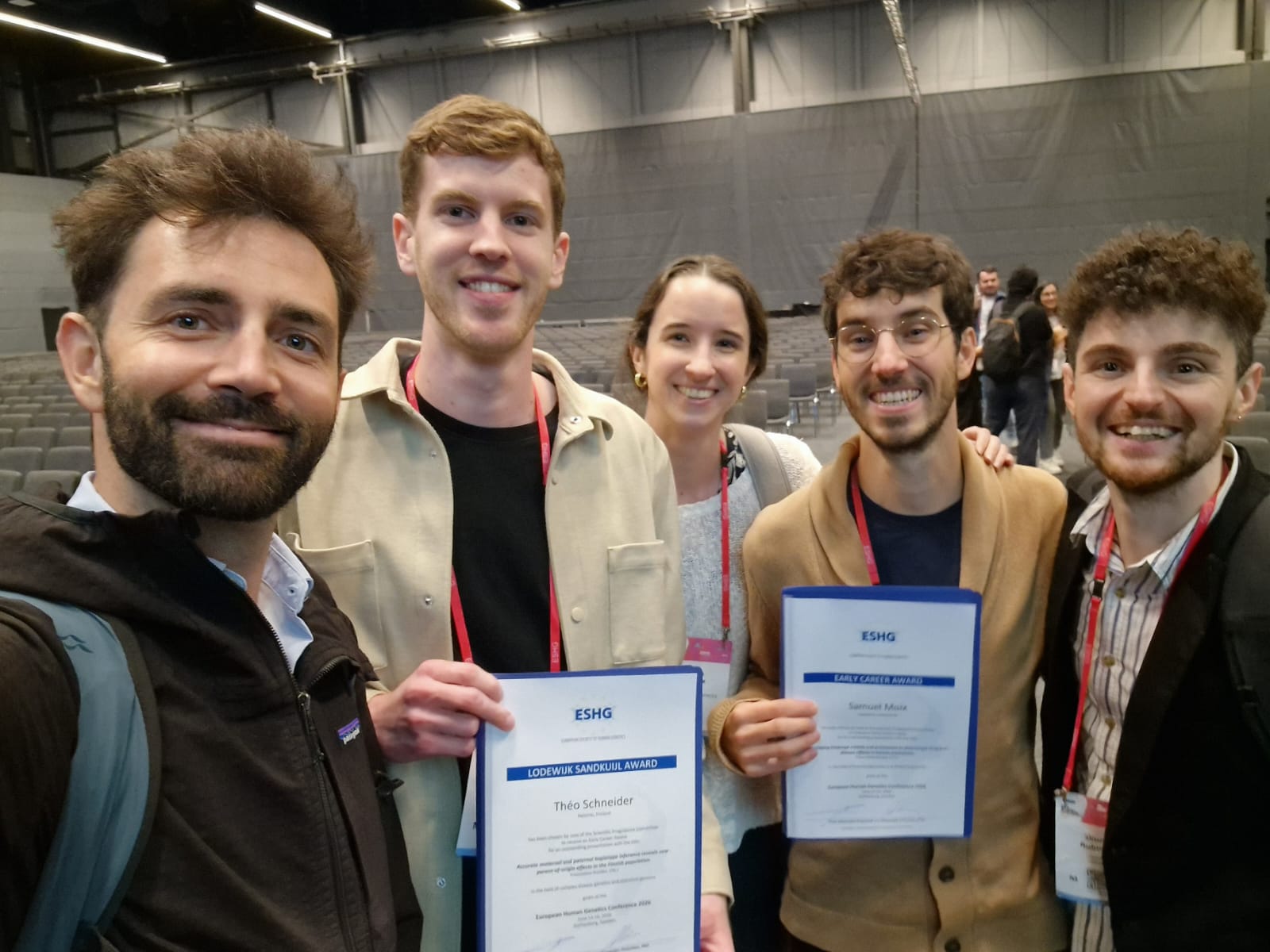
Maarja and Francesca had posters, Marinella and Théo gave talks, and Théo won the Lodewijk Sandkuijl Award for the best presentation in complex disease and statistical genetics. I am very proud of him. He received it alongside Samuel Moix, and we celebrated together with two previous winners, Robin Hofmeister and Chiara Auwerx. Chiara was Théo’s supervisor during his master’s, so it was nice to have them in the same picture.
What stayed with me
I have been doing statistical genetics for about ten years. For a good part of that time, the field was finding associations much faster than anyone could explain them. I am not complaining, the scale we reach now is impressive. But when you have a thousand loci, the hard part is what comes after. Which variant is causal? In which cell does it act? What does it actually change? And are we measuring the right thing?
The last question came back many times in Gothenburg. A variant can act on translation and leave transcription alone. It can have an effect only in one cell state. A missense variant can change what a protein does without touching its expression or its abundance. Some regulatory variants show you nothing until you perturb the system.
So I did not come home excited about one specific technology. What I noticed is that more groups are asking these questions at several molecular levels at the same time. Here are some of the talks.
Measuring the wrong thing
Soumya Raychaudhuri talked about the CD40 autoimmune risk locus. If you run a standard eQTL analysis in resting B cells, you see basically nothing. From that alone, you could easily conclude that the variant does nothing in B cells.
His group used CRAFT-seq (originally called MINECRAFT-seq, and I am a bit sad they changed it) to perturb the variants and follow the effect in single cells. The protective variant sits in a Kozak sequence. It changes how efficiently the CD40 transcript is translated, while the amount of transcript stays about the same. B cells end up with less CD40 protein on the surface, and the RNA barely moves.
In monocytes, the same region has a normal transcriptional eQTL. But that does not seem to be the mechanism in B cells.
One variant, and you get different answers depending on the cell type and on what you decide to measure. An eQTL tells you one consequence of a variant, in one context. Everybody knows this, but when you work with huge molecular QTL resources it is easy to forget it, and to start treating the variant-to-gene links coming out of eQTL pipelines as if they were the full biology.
The clinical version: VUS
Heidi Rehm came at a similar problem from the clinical side. She followed what happens to Variants of Uncertain Significance over time. Many ClinVar submissions are still VUS, but some are much more uncertain than others. Her group split them into lower- and higher-probability VUS and looked at how the classifications changed as evidence accumulated. About 80% of the lower-probability ones ended up Benign or Likely Benign, and the pathogenic reclassifications came from the higher-probability group.
I liked having real numbers on something that we usually just call “variant interpretation”.
For very rare variants, and singletons especially, the limit is simple: one observation does not tell you much. You need more carriers, or some independent evidence. This is why federated efforts like gnomAD v6 interest me. Putting more genomes in one database only goes so far. The harder problem is learning from rare variants across many cohorts while each cohort keeps its data at home.
Beyond RNA
A related theme: we still use RNA as a proxy for biology in many cases where the interesting effect happens somewhere else.
Hilary Finucane mapped missense variants onto 3D protein structures to understand how different variants disrupt ion channels in neuropsychiatric disease. For these variants the question is what the amino-acid change does to the protein, and expression is almost irrelevant. With gain-of-function variants this is very clear: RNA levels can be completely normal and the protein can still behave in a very different way. RNA-seq cannot see this.
Elise Needham showed phospho-proteomics in metabolic tissues. One missense variant changed a specific phosphorylation event, and the effect spread through a larger signalling pathway. If RNA abundance is your only molecular phenotype, you miss all of it.
Honestly, a lot of statistical genetics is built around gene expression because it is easy to measure at scale. It has been very useful and I don’t want to say otherwise. But easy to measure and biologically relevant are two different things, and sometimes the informative phenotype is several steps after transcription. How to combine all these layers without producing yet another giant association map that nobody can interpret, I don’t know yet.
From association to perturbation
For me this was the most exciting part of the meeting.
Hamish King used single-cell CRISPR activation screens in primary human B cells to study non-coding autoimmune variants. What I liked is how directly the genetics and the experiment are connected. GWAS and QTL signals decide where to perturb, and the screen tells you what happens when you change that region. It is also done in primary B cells, the cell type where the variant is supposed to act, instead of an immortalised line where a transcriptional response may or may not mean something for the disease.
CRISPR screens are not new. It was my favourite talk because it goes straight at the problem statistical genetics has had for years: very convincing associations, and very few mechanisms.
Adriaan van der Graaf presented statistical work connecting functional CRISPR screens with population molecular QTL data. Population data tell you which parts of the genome matter in real humans, with limited mechanistic resolution. Screens give you control and a direct readout, in a system that is necessarily simpler than a human. Neither is enough alone, and making these two kinds of evidence work together is a very good problem for people like us.
”Causal variant”
After this week, “causal variant” feels like several claims packed into two words. That the variant is associated with the phenotype. That it is the causal one and not a neighbour in LD. That it acts in a certain cell type, under certain conditions. That it works through transcription, or translation, or protein structure. That perturbing it reproduces the molecular effect. And finally, that this molecular effect explains something about the human phenotype.
Each part of the field is good at some of these. Fine-mapping tells us where to look, single-cell QTLs give the cellular context, proteomics and structural biology show effects that are invisible at the RNA level, and CRISPR perturbations are the closest thing we have to an experiment. At ESHG I saw more projects using several of these together, and I was happy to see it.
Back home
I don’t think ESHG 2026 says we are done with GWAS, eQTLs or statistical genetics. We need them to know where experimental effort is worth spending. But finding the association is where the work starts: which cell, which state, which molecular layer, what happens when you perturb it. Integrating these data is still a hard computational problem, and the experiments bring their own uncertainty. At least the questions are now concrete enough to work on.
Thanks to everyone I talked with in Gothenburg, over coffee, over dinner, and over too many late beers about parent-of-origin effects.